
Look and Feel
Model Suitability (out of 10):
Attributes (out of 10):
Contrary to what many think, Kraft is a high end paper. In German, Kraft means “strength”. The name is actually derived from the Kraft process that converts wood into wood-pulp consisting of almost pure cellulose fibers.
Kraft has no lignin (or almost none). Low lignin is important to the resulting strength of the paper since it weakens the connections between cellulose in the fibers. It also has the tendency to oxidize, making the paper yellowish and crispy with time.
Since there are no extra materials added in the process, Kraft usually has a brownish color and a rough texture. Bleaching is possible but it weakens the paper and, for many purposes, strength is more important than beauty.
In the origami world, Kraft usually means low quality, unwanted, always waiting at the bottom of the pile. As a generic type, again, we have a problem reviewing it. I have 8 different types of Kraft paper in my stock and the variety is enormous. There are colored Kraft, white Kraft, coated Kraft, Duo Kraft, thin and thick Kraft, for various uses such as wrapping and cardboard manufacturing.
With so many options, we had to juggle between the idea of reviewing the generic Kraft, but also to evaluate one particular product which is sold as an origami paper, hence making this review more beneficial for the reader.
We chose Kraft paper from Origami-Shop. It may be the only paper that is sold as a draft or test paper. Again, this raises another problem for us - even the seller doesn’t see the aesthetic value of it. In order to do justice to the paper, we have put this bias to one side.
Properties
- Thickness: our test paper was 35 gsm, although the stated value is 28 gsm. The thickness is 50 microns, by far the thinnest paper we have tested. Origamido® is 65 microns.
- Sizes: The pre-cut options are minimal, but sufficient - 15×15 cm, 30×30 cm, 40×60 and 48×48 cm. There is no full sheet option. Otherwise it is purchased in rolls.
- Colors: This paper is tagged as Test Paper and the only color you get is light brown. Again when purchased in rolls, or from other makers, many colors are available.
- Paper Coloring or Colorability: applying water color (by Ecoline) gave good results. The paper buckled very little, and with careful painting a homogeneous color can be achieved. Unfortunately the paper shrank noticeably! I had to cut off 2 mm to get the paper square again.
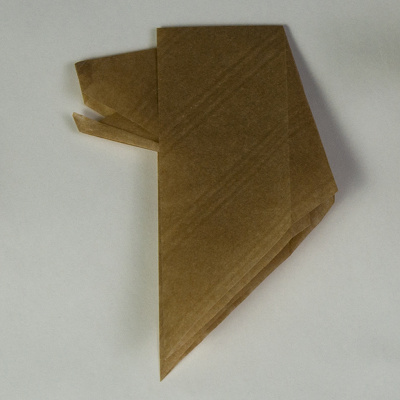 You can usually recognize Kraft paper due to its characteristic stripes on one side of the paper.
Texture: One side is coated with a smooth, translucent layer. The other side is striped, easily showing the grain direction. The paper is transparent, put it on your hand and you can clearly see its contour or even color. Raise it to the light and you can see how the pulp was spread on the felt drum in the machine.
- Aging and Wear and Tear: Sorry, but very little data here. We, and our colleagues, have no models from this paper other than the ones we have tested now. In the Tear Machine it scored 204 and 247 (with and against the grain respectively), much less than printer paper (510/580) and very close to the Crumpled paper. Being so thin, it shows its strength.
- Memory: Very good. Make a crease and a visible line appears. Open up the paper and it will curve on both sides and not lie flat. 9 out of 10.
- Forgiveness: Fair to good. When you try to reverse a fold that goes against the grain, it breaks backward nicely and easy. But try to do that with a fold that goes with the grain, and it’s difficult to do it accurately. 5 out of 10.
- Tensile Strength: We refer here to the maximum stress the paper can undergo while being stretched or pulled. This test is done by a machine, and it’s easy to compare to other papers. The value for this paper is 3.8kg and 1.8kg - it is a bit more than half of printer paper (7; 2.9 Kg), but with only a third of the weight. 8 out of 10.
- Bending Resistance: This section rates the amount of force you need to apply to get a sharp crease and how strong the paper is while being curved (like during the puffing of the PowerPuff unit). This, too, is measured by a machine. Curving is not a strong feature. The numbers (6 to 10) are very low. 4 out of 10.
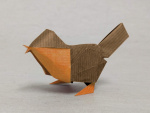
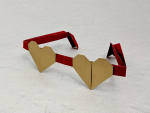
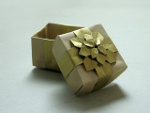
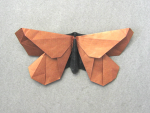
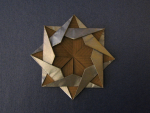
- Photogenic: This paper has no ambitions in this field. It’s a test paper. Nevertheless, there is some flare to it. See the images to decide for yourself.
- Where to buy: Tricky question. As pre-cut squares it is sold in Origami-Shop.com. Other origami manufacturers also supply colored Kraft or Kraft-like paper (e.g. www.paperfrog.de - all papers that have the characteristic stripe-pattern)
Test results
Traditional use
Traditional Crane, 15×15cm

The strongest impression I got was "Sharp!" It was very easy to get a very accurate result. Opening the wings requires reversing all the folds, but since they are not going exactly with or against the grain it was not a major problem.
Action model
Being so thin, the springiness value is extremely low.
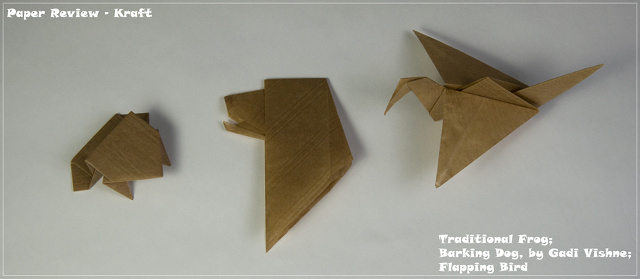
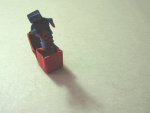
Barking Dog by Gadi Vishne, 15×15cm
The dog barks, the push mechanism worked just fine.
Traditional Flapping Bird, 15×15cm
The Flapping Bird flapped well; the wings held up, never sagged and returned sharply into place when you let go of the tail.
Traditional Jumping Frog, 15×15cm
The frog hardly jumped.
Tessellation
Pineapple tessellation by Ilan Garibi, 48×48cm

Oh, the temptation! Thin paper always drives me into a bit of madness and to reduce the molecule size. From a 48cm square I decided to try and make a 10×10 molecule tessellation which requires a 64×64 grid. Unlike other models, tessellations require many crease lines parallel to the grain direction. Since I always reverse my grid in both directions, it was a taxing job with this paper. Doable, of course, but to repeat it 64 times was far from relaxing. The nice effect of this paper, showing the crease lines vividly (especially lines that go against the grain, because of the strips on the other direction), was very helpful, and completing the pre-creases went well. With each square at a size of 7.5mm, the paper enabled accurate results. The collapse was done in two phases and the first one went perfectly. Then disaster struck! The second collapse phase requires some bending resistance. You need the small surfaces to stay flat and not to sag away, so that they can snap into place. This can be done easily with the outer molecules, but from the second line inward it was almost impossible. My wife urged me to give up, but I am a stubborn man, and disagreed. The final result, I must say, is mesmerizing. Although the back part is far from clean, the front is marvelous. I managed to rearrange all petals and flaps to the right position. But it was a lot of work.
Mystery tessellation by Ilan Garibi, 22×22cm
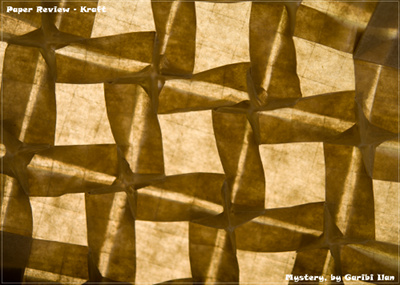
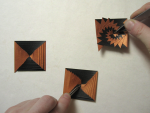
I folded this only for the back light image. I just love this paper with back light!
Complex
This section should be its bread and butter, and it is.
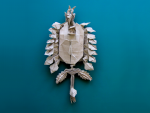
Pegasus by Satoshi Kamiya, 30×30cm

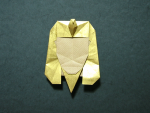
Owl by Katsuta Kyohei, 30×30cm

Since complex folds are the strongest point for Kraft, I decided to try this model from the cover of the 17th Tanteidan Convention Book. Box-pleating the body went extremely well and shaping the wing tips, with many feathers, was just as easy. I managed to succeed on my first try to complete all but the talons, but not because of the paper. The paper was responsive and therefore easy to shape and fold even tiny details.
3D models
Rat by Eric Joisel, 15×15cm

The rat was very easy to fold. All went well, and there was no problem with the many layers at the back. The final result is satisfying, but can hardly stand on its legs.
Fox Terrier by Francisco Javier Caboblanco, 20×20cm

I used the colored paper. Easy to fold, easy to shape without any wet folding, due to the stiffness the color gave it.
Dwarf by Eric Joisel, 30×30cm
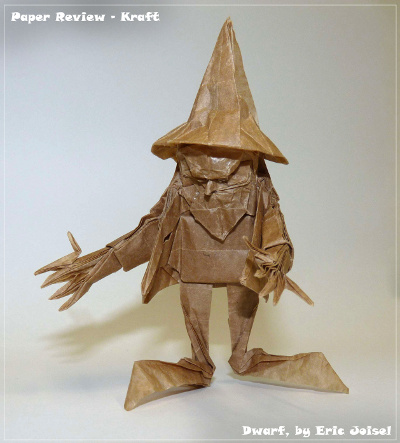
This is a classic model, based on a box pleating technique and asks for a lot of shaping at the end. We folded it together, and both agreed that box pleating it is tedious, fighting with reversing creases (that go with the grains; against it the paper snaps backwards much easier.) Trying to fold many layers together is easy but they tend to open up. Shaping at the end was rewarding, getting all the details easily.
Final verdict
This is one of the most difficult papers to summarize. As a test paper it has many benefits - it`s extremely thin yet it’s strong and it’s accurate. But there are short comings - it’s difficult to reverse creases, the pattern on the bright side may make it tricky to find the creases and it’s not easy to manipulate. We felt that the better folder you are, the more you can exploit this paper, but being a test paper, it would be used by novices who may have some difficulties with it.
So here is the paradox - as an origami paper, it’s a very good for complex models, but it doesn’t have the right look! As a test paper, if this is the first time you try a model, it may be too difficult to handle.
I couldn’t find models on flickr that are made from this particular Kraft. More than 1000 resulted when I searched for the generic Kraft paper, with models from all ranges and types, mostly animals.
Bottom line: good for complex, but for the experienced folder.
Related videos
Related images
Comments
Submitted by Sara on 29 January 2012 - 1:30pm Permalink
Thin Kraft: Perfect for Crumpling
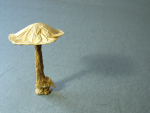
These reviews don't include crumpling - which is understandable, as only very specific paper can be used for it. It's worth mentioning, though, that the thin Kraft paper that was tested here (sold as 28gsm) works extremely well for this flavor of origami. For example, check this picture of a Mushroom by Vincent Floderer I achieved with the same paper: http://www.happyfold...
As a side node, I was motivated to try crumpling, because I was folding a highly complex model with Kraft and made some mistakes. The incorrectly placed precreases distracted me, so I decided to start over. But that large sheet of paper did want to be formed into a model still. Thankfully, when crumpling, it doesn't matter if the paper already has a couple of creases on it. :)
-- Sara
Submitted by Anonymous (not verified) on 3 December 2012 - 12:49pm Permalink
Kraft Paper to insects
Hello!! In my blog: www.youjiland.blogsp... I have some insects folded from this paper. There is an octopus too! The results are great.
Minami
Submitted by Anonymous (not verified) on 8 February 2012 - 3:08pm Permalink
What about modular ?
Many compliments for the review, I found it's particulary high value on the pre-starting job: about the choice with so many option on availability, finding and purchasing it, make me feel as if I'm reading a scientific article.
By reading it I can make me the idea that it's not a good paper for modular...
As a modularist I think that it's not reasonably thickness to be tested on modulars, but since it's mentioned on the "Bending Resistance" section I thought I will found some words or examples on this origami fields.
Anyway a great article.
Compliments Ilan.
Thanks Sara.
By
Ale --
Submitted by Sara on 10 February 2012 - 7:31pm Permalink
Depends
Well, I've folded quite a few modulars with the slightly heavier Kraft paper. That works really well.
As to the thin Kraft (28 / 35gsm) that was reviewed by Ilan Garibi and Gadi Vishne - I'm guessing it doesn't have enough body to be all that useful for modular origami.
-- Sara
Submitted by Adolfo cavolacc... (not verified) on 25 June 2017 - 11:56pm Permalink
Kraft+Kami
Hi,
I've tried to glue a Kami sheet with a kraft sheet, and i've noted that is you glue the colored side of the Kami sheet to the kraft, you will obtain a nice paper with a strange color (an example: when you glue the color side of a pink/orange Kami on the kraft, you will obtain an earthenware/white duo colored paper)
Sorry for my English.
Submitted by Adolfo cavolacc... (not verified) on 17 July 2017 - 9:54pm Permalink
White and blue thick kraft
Hi,
I've noted an error in your review. In the "colors" paragraph, you say that kraft is available only in one color, but it's available also white and a thick blue kraft.
Submitted by Sara on 18 July 2017 - 9:44pm Permalink
As time passes...
Thanks for pointing this out.
As time passes, origami shops discontinue articles or extend their offerings. Back when the article was written, origami-shop only had that one color and weight. So you are right, that information is a bit out of date, but the general properties will still be the same, so I believe the article will stay valuable even if the section on available colors and shops that sell it aren't up-to-date.
-- Sara