
Look and Feel
Model Suitability (out of 10):
Attributes (out of 10):
Tissue Foil is a rare product. The combination of the stiffness and strong memory of the foil, with the look and agility of the tissue paper makes a promising paper to answer many of our paper-folding needs. For year now the only solution to obtaining tissue foil was to make your own and many still do.
To make some, you have to bond foil (sold as a kitchen product) with whatever Tissue paper you have. Truth be told, it's a lot of hassle, and it's difficult to obtain a perfect result. That is why we were happy to see what may be the perfect solution - Ready Made Tissue Foil.
It is sold exclusively in Nicolas Terry's online shop (origami-shop.com), and everything about it is kept secret. I know it is made by a Thai paper mill, but have no idea where, or what the ingredients are. All I can say about the paper is purely from our experience folding it, but is it good as it should be?
Properties
Although all colors are sold under the same title, there are some major differences between the various colors, and sometimes between same colors but different sizes. This may be due to the manufacturing process or variations in the materials used. However, since it is sold together as a pack, we will consider that as one paper type, with variations.
- Thickness: The weight is around 50gsm, but the paper is not as thin as you may think. The thickness is 115 microns, slightly thicker than printer paper (which weighs almost double: 90gsm).
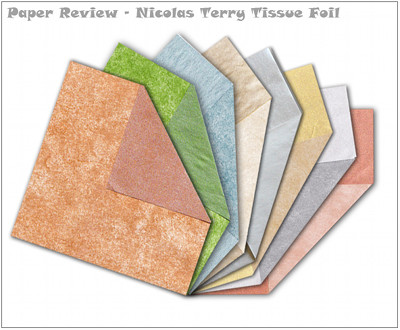 A small, yet smartly chosen color palette, with red and black to come in shortly (image by Nicolas Terry).
 - Sizes: There is a good range of sizes to accommodate most origami needs. 15cm (approx. 6in), 20cm (approx. 7 3/4 in), 30cm (approx. 11 3/4 in), 40cm (approx. 15 3/4 in) and 60cm (approx. 23 1/2 in) squares are available.
- Colors: There are 8 colors - gold, copper, silver, champagne, white, green, brown and light blue. Since it is a double color paper, each paper has a unique tissue side. The brown, silver and copper have the same color without the shiny effect. The white, champagne and some sizes of the gold have a white, half translucent, side that lets the foil side color filter through. The blue and green have white patches on the other side (see the crane), but they mostly keep the same color. I know it's confusing, but on the positive side is you have a reasonable variety of colors and effects to choose from. See in the image above how the same foil colored sides appear with different tissue sides.
- Paper Coloring or Colorability: It was only sensible to apply water color (by Ecoline) to the white paper, but it is too transparent for it to be colored on the tissue side only, since the color is highly visible from the foil side. The foil side is un-paintable, so unfortunately you can only use the original colors, or a completely re-colored white!
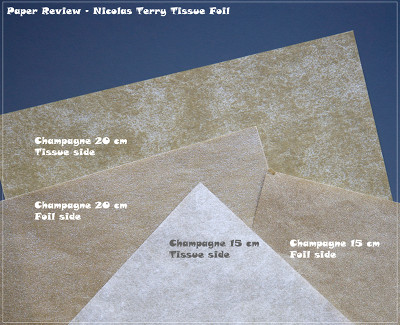 Not all papers are made equally.
Texture: The tissue side is a bit rough, and has the look and feel of a high end handmade paper. The pulp was spread unevenly, as can be seen with some back light. The foil side doesn't appear to be a real foil, but more like a sprayed metallic color has been applied. This is a guess, but it is reinforced by the glitter that stuck to my fingers during folding. It also seems that every sheet or batch of sheets is soaked for a different length of time in the paint. This causes each color to behave a little differently. The brown is stiff while the Champagne is soggy. All other colors are in between, but more on the stiff side.
Supporting my guess about how it is made, the paper is slightly translucent. I put the white paper on a book and I could read the title. All the other papers allow a little light to go through (see the detail of the Pineapple tessellation).
Unlike foil, there is no sharp reflection from the foil side. Although it has a matte finish, it glitters in the light.- Photogenic: Without the shiny effect of a true foil, the camera loves this paper. the tissue side has a matt finish that looks really amazing and rich.
- Aging and Wear and Tear: We have very little experience with this paper, so we don't have any aging information. Some reverse folds on the edges of the paper ripped, but only where the force was applied. The tears do not tend to continue since the Tissue side seems to have long fibres, but our feeling is that this paper is very strong and shouldn't have ripped.
- Memory: Very good. Although not truly foil, this paper does feel like a true tissue-foil paper. Make a crease and it will stay. Flatting the paper after a crease, there is a visible line that you can feel by a finger touch. 8 out of 10.
- Forgiveness: Good, almost very good. Unlike real foil, it is easy to reverse a fold with this paper. Since there is a range of sturdiness here, the more sturdy papers behaves better in this property. 8 out of 10.
- Tensile Strength: We refer here to the maximum stress the paper can undergo while being stretched or pulled. Tested by the machine, the value for this paper is 2.5 Kg, in one direction, with 7 mm stretch. In the other direction, the weight it can hold before tearing apart is 3.6 Kg, and it stretched by 6 mm! It's a bit stronger than Kraft and it got the highest score in stretching before the paper breaks. 9 out of 10.
- Bending Resistance: This section rates the amount of force you need to apply to get a sharp crease and how strong the paper is while being curved (like during the puffing of the PowerPuff unit). Curving is a strong point. The paper is sturdy and behaves like it is much thicker. A sharp crease can be achieved easily with your finger nails and a visible white line appears, like with tracing paper. 8 out of 10.
- Where to buy: There is only one place - Nicolas Terry's Origami-Shop. You cannot find it anywhere else.
Test results
Traditional use
Traditional Crane, 15×15cm
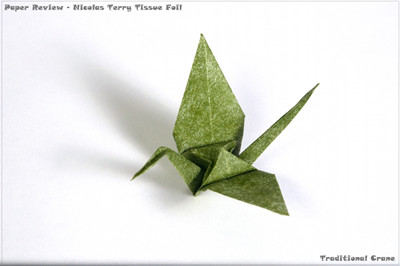
It felt like overkill - the paper is too good to be used for simple models as such. Nevertheless, if you can afford it - it is highly recommended.
Action model
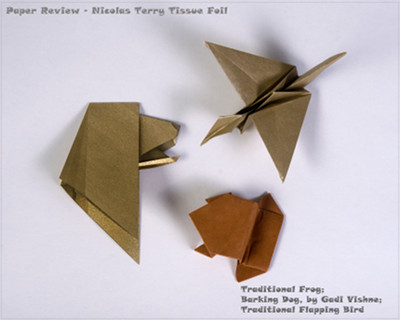
Barking Dog by Gadi Vishne, 15×15cm
The push mechanism worked just fine with the dog (made from Gold paper).
Traditional Flapping Bird, 15×15cm
The bird, from Champagne paper held its wings, but looked a bit tired, so to speak.
Traditional Jumping Frog, 15×15cm
I used the Brown paper for the frog, but I was unable to determine the direction of the grain by hand. It is the stiffest paper, and the frog I made performed many somersaults, but didn't jump very far.
Tessellation
Pineapple tessellation by Ilan Garibi, 40×40cm
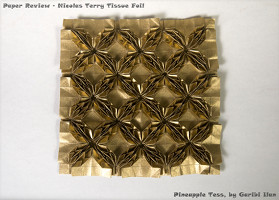
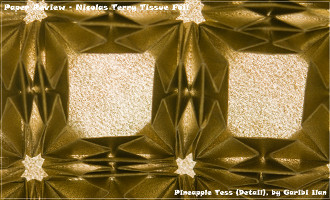
I decided to use the golden paper, with the shiny side up. I have never folded such an accurate grid. Usually the paper tends to distort while being folded with many parallel lines, but not this paper. There was little difference between “with” and “against and both were very easy to reverse. My hands were covered with golden dust during the process, which strengthens my theory about the foil side being sprayed. Pre-creases went perfectly well; the crease line on the tissue side is highly visible, and the diagonal lines tend to fall exactly on all the crossings of the grid. The collapse was easy with all the outer molecules. The centre molecules are usually difficult to handle, but here it was no big deal. Again the paper keeps its square proportions, so all molecules look the same and undistorted. The final result, as well as the process, is very satisfying!
Complex
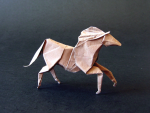
Pegasus by Satoshi Kamiya, 40×40cm
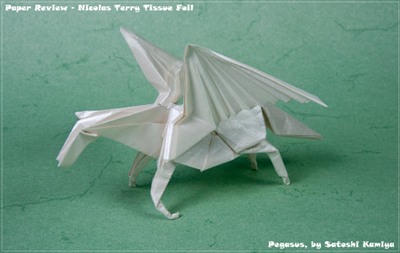
I saw no point in making the sheet smaller, so 40 cm was the size. “Being a mythical creature”, my wife said, “go with the shiny side”, so I, obediently, did. Folding went easy, it's like the paper is helping you, going exactly where you want it to go. “Can it be that good?,” you ask yourself in the process. The sinking of the belly was done sharply. The shaping of the legs, head and tail went well, but for the tiny details of the hooves I still felt the paper was too thick.
Owl by Katsuta Kyohei, 40×40cm
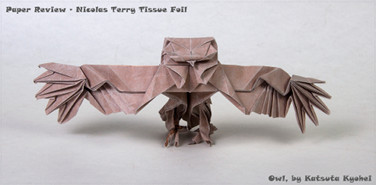
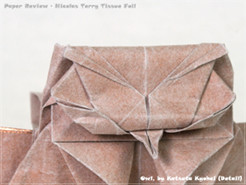
Yeah, it's not the usual size, but I didn't want to cut it. I had a difficult time choosing - not only the color, but also which side up. I chose the brown/bronze paper, and the tissue side up From the first fold, the experience was wonderful! It's a perfect paper for box pleating. Every step is just easy. Reversing a fold - a piece of cake. Open sink - no problem. Close sink - just the same. The wing tips are so sharp - what a pleasure!
Unicorn by Satoshi Kamiya, 30×30cm
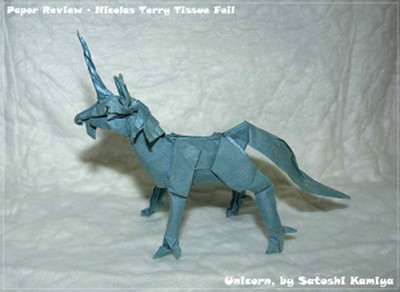
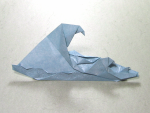
The blue tissue foil gave me a fight in the last steps, since the unicorn is made with many layers of paper, as you can see in the head. The final shaping holds well, as one can expect from a paper that has foil in its name.
Dwarf by Eric Joisel, 30×30cm
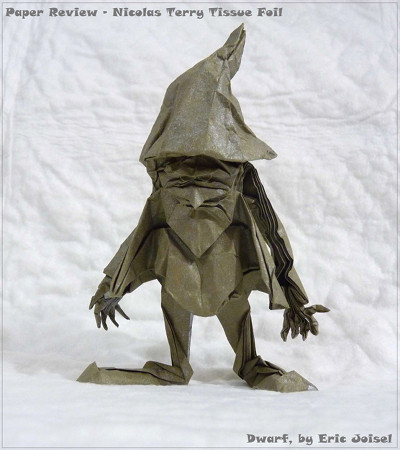
Making the details of the dwarf`s face asked for many stretches and pulls with a tweezers and no tears occurred. With the Champagne it was not easy to reverse folds. The final shaping holds well, as one can expect from a paper that has foil in its name.
Modular/Unit Origami
PowerPuff modular by Ilan Garibi. 30 units, 12.5×12.5cm
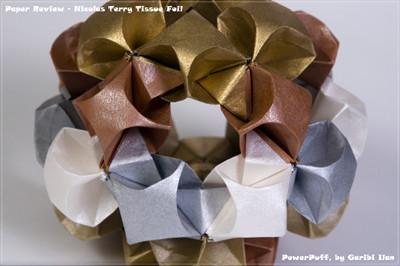
I made the units using 4 colors. The brown behaved perfectly. Easy to fold, reverse fold and the puff went well. The curved surface of the unit is very strong. The light gold was too soft. It was folded alright but the tabs felt too weak. Assembling went well, and the final result is just lovely.
3D models
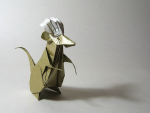
Rat by Eric Joisel, 15×15cm, 7.5cm×7.5cm
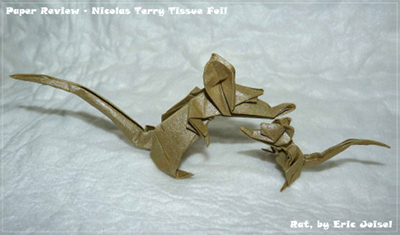
I chose the wrong paper - the champagne color. It is too weak to hold the rat on its legs. This paper is softer than the other ones, and I found that reversing a fold is a bit tedious. But beside that all went just flowingly. It is an excellent paper to fold with.
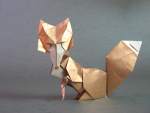
Fox Terrier by Francisco Javier Caboblanco, 20×20cm
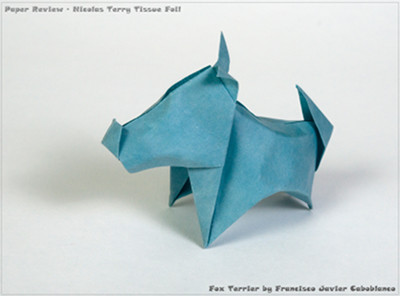
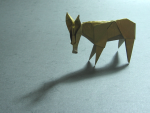
It is a simple model, and the paper made it even easier to fold. Shaping the ears, legs, head and tail using the foil advantages is easy, but I was surprised to see the legs open up to the sides more than I thought it would. That is why I decided to try some wet folding. Yes, wet folding on a foil paper seems to be useless but here it worked perfectly. Since I used the tissue side on the outside, it did absorb some humidity that allowed me to shape the legs at will. After just a few minutes it was dry and well shaped!
Polar Bear by Giang Dinh, 15cm×15cm
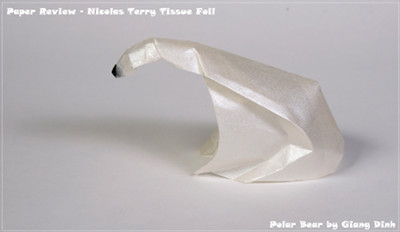
Foil papers are made to make 3D animals easily, so I tried to dry fold this model. For this model, and the way Giang teaches his models, there are no definite instructions: “fold around here to somewhere in between”. So I got the head too little, but the general shape as well as the legs and body contour went very well. The paper is strong and stiff enough to be shaped at will.
Final verdict
This is definitely a favorite. One of the best papers we have ever tested or used. It's as if it was made for origamists. Hey, wait, it IS made for origamists, and it is doing its job perfectly. It's strong, yet thin; it is stiff, yet folds easily; it has a beautiful palette of colors, and it comes in all the right sizes.
Folding simple models is an easy task, as well as simple action models. For modulars it has the look as well as the friction to hold units together. 3D models benefits from its foil side for shaping and the Tissue side for the texture. For complex models it is highly suitable, making you a better folder. For tessellations it is surprisingly excellent. It's easy to fold an accurate grid and it has a “snap into place” collapse. Like any other foil paper it's not really suitable for wet folding, but for extra shaping a little spray of water works very well.
In flickr - 1,555 results came from searching for Tissue Foil, but most are handmade papers. I narrowed it down by adding “Terry” to the search, and got 229 images. In both cases Tissue Foil is used for 3D animals and complex models, many are insects. It is rarely used for complex stars, and neither real tessellation nor modulars have been spotted.
Bottom line: one of the best!
Related videos
Related images


Comments
Submitted by Flo (not verified) on 9 August 2016 - 3:09am Permalink
Aging of the paper/color
Approximately a year ago i folded Skuki Kato's Western dragon and also Kamiya's Phoenix with this paper and when I compare pictures from directly after the fold with now I noticed that the color has bleached quite a bit. The red of the dragon looks more like a light red now (almost a rosy pink) and the yellow of the phoenix is also a couple shades lighter now. Also both models were standing in places with no direct sun onto them
Submitted by Adolfo cavolacc... (not verified) on 4 July 2017 - 6:29pm Permalink
Wet folding: loosing color
Hi,
A month ago I've tried to wet fold brown tissue foil for a model, but, when I'd added water to the sheet it began to loose brown paint.
It is normal? Your review doesn't say anything about this...
Thanks and sorry for my English.
Submitted by Jeongwoo (not verified) on 6 October 2018 - 9:06am Permalink
Suitable folding
Hi I've used this paper a couple of times (but only the gold variant which has sparkles) but don't know if green Nicholas terry tissue foil (probably 60x60cm) would be suitable for Jason Ku's HJ rex he made. I know that this paper can hold the shape very well and the size will be plenty to make this model comfortably but just by looking at the model I was concerned about the thickness of this foil and how it would hold up against the many layers of this HJ rex and if these would lead to problems with shaping the model. And if I should just stick to another paper (that holds the shape, is thin and strong) and what would be a good recommendation for a model like this.
Thanks.
Submitted by PURPLEPICKLE38 (not verified) on 8 March 2019 - 10:50pm Permalink
Nicholas terry tissue foil.
I personally hate this paper, the score you gave it is way too high. In my opinion printer paper deserves a higher score. Every time I have used this paper it fails. One of the weakest paper I have ever used, doesn’t do well with lots of layers. I tried to make oriol esteves squirrel and I didn’t turn out. Also tried with Lang’s redpath pteranedon and it failed. It rips very easily and would rate almost every paper higher than this. In my experience, this is one of the worst papers I have used. Lokta is so much better especially with mc for shaping.