
Submitted by Sara on 10 February 2009 - 9:44pm
Designer:
Gjerde, Eric
Folder:
Adams, Sara
Difficulty Level:
Intermediate
Model type:
Triangle Grid
Tessellations and Fractals
Paper ratio:
Square
Review of the paper used:
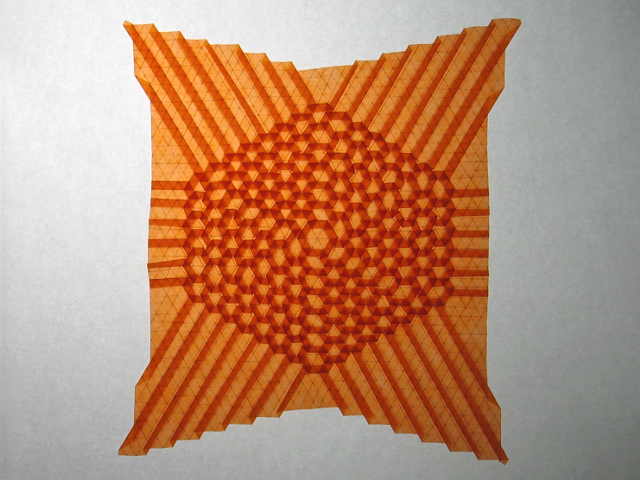
Yesterday night I first tried the model on a triangle grid with 16 pleat divisions to get a feel for how to do the model. I then moved to transparent paper, and had this stupid idea of doing a triangle grid 64 pleat divisions instead. Hours later... this is the result. This is what robs my sleep!
Paper: 19.5cm square of transparent paper
Model: 15.3cm x 13.7cm
Comments
Submitted by Daniel (not verified) on 11 February 2009 - 5:07pm Permalink
WOW!
It looks amazing! I only moved on to 32 pleat divisions. By the way the diagrams of this tessellation is also located in Eric's blog. Here is the link: http://www.origamite...
Submitted by Adam (not verified) on 12 February 2009 - 3:57pm Permalink
64 pleat division.. That's
64 pleat division.. That's insane! I've only gone to 32 on a 15x15cm sheet so far, so your triangles are nearly twice as small as the ones I made. I'm quite amazed by the fact that you managed to crease everything quite precisely at this microscopic size.
Submitted by Sara on 12 February 2009 - 11:15pm Permalink
Precision
I think tessellations will help me improve my precision. I also found that transparent paper helped me align creases, and thus get higher accuracy. Plus, of course, you get nice effects when applying back lighting to the finished model, as I did for this picture.
Submitted by Child of Ra (not verified) on 15 February 2009 - 6:50am Permalink
Excellent maner of practice!
This will help with your fish scales too! (the koi fish project, remember, Sara???)
Submitted by Sara on 15 February 2009 - 11:51am Permalink
The Koi!
I do remember, and I've had the same thought already. :)
-- Sara
Submitted by Child of Ra (not verified) on 15 February 2009 - 6:48am Permalink
Breathe in the feeling of accomplishment!
Mathematically speaking, a hexagon is the perfect shape, since it holds basic principles in all 9 dimensions.
Submitted by Eric Gjerde (not verified) on 18 February 2009 - 2:12am Permalink
Great work!
You've done a fantastic job here - wow! And I also can't believe you jumped right into a 64-division folding job... that's pretty amazing.
Thanks for sharing this, I'm really pleased to see such happy feedback! :)
Submitted by Anonymous (not verified) on 27 September 2009 - 10:23am Permalink
please
Please make a video on this tessellation.
PLEASE PLEASE PLEASE
Submitted by Anonymous (not verified) on 5 July 2010 - 12:30am Permalink
how it was folded
do you have to do triangle twists on this model because i could see that there are little triangles on the hexagons and eric gjerde made instructions on how to make hexagons by triangle twists on his website.
Submitted by Sara on 5 July 2010 - 4:11pm Permalink
Only pleat intersections
This model is solely based on 120 degree pleat intersections. You do not need any triangle twists.
-- Sara
Submitted by czech origami s... (not verified) on 18 December 2010 - 1:00pm Permalink
Combination
That is excellent! I really thank you for your videos, look on my crazy idea :) http://picasaweb.goo...
Submitted by Anonymous (not verified) on 21 April 2011 - 11:44am Permalink
cool
I made the one with 32 divisions and that was hard too.
Submitted by Anonymous (not verified) on 9 May 2011 - 6:06pm Permalink
hard for sara
you guys i buy the book yust waths this video http://www.youtube.c...
Submitted by Anonymous (not verified) on 27 June 2012 - 11:34pm Permalink
Just wanting to share my attempt at a 64 stage
http://imgur.com/6N62q
I made this out of a regular square cut out of a sheet of A4 copy paper. I went ahead and did all the hexagons all the way to the edge of the paper on two sides so I could have a regular hexagon as the overall result. Thanks for looking.
Submitted by Sara on 28 June 2012 - 6:21am Permalink
Neat fold!
That looks great! You worked very precisely. :)
-- Sara
Add new comment