
Submitted by Sara on 10 July 2009 - 10:31pm
Designer:
Gjerde, Eric
Folder:
Adams, Sara
Difficulty Level:
Intermediate
Model type:
Triangle Grid
Tessellations and Fractals
Paper ratio:
Hexagon
Review of the paper used:
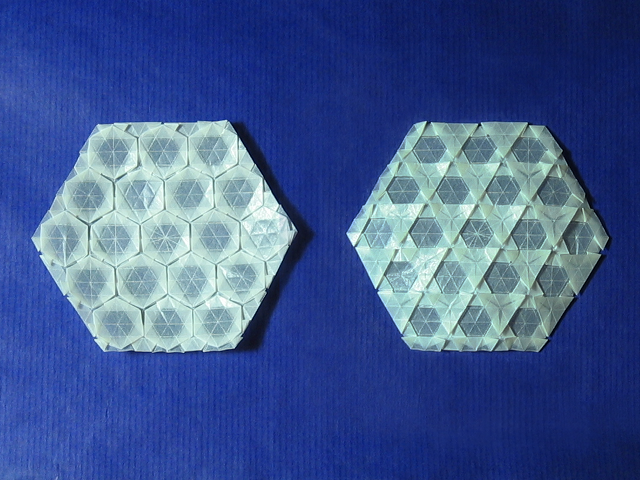
Some time ago I started this tessellation, and didn't have time to finish it. I'd only done the grid and the first rabbit-ear triangle sink fold. I had a hard time figuring out how to do that one. Today I decided to complete it, and thankfully I immediately got how to do the rabbit-ear triangle sink fold, and after some fiddling this is the result. The pictures shows the model from both sides. Given the name, I'd say the right one is the front view, and also the side I think I prefer. But with tessellations you can always decide which side you like best.
Paper: hexagon from a 19.5cm square of transparent paper (side length of hexagon: 10.5cm)
Model: hexagon with a side length of 5.5cm
Comments
Submitted by Anonymous (not verified) on 11 July 2009 - 7:39pm Permalink
Wow
Rabbit-ear triangle sink fold?
That almost sounds like Inside reverse fold when I first started origami.
CoolAwsome model though.Submitted by Anonymous (not verified) on 15 July 2009 - 8:39pm Permalink
Oh yes, it's a horrible name for the fold...
I completely agree that it's a rather unfortunate name for the fold, but I was at quite a loss about what to call it. It's a triangle sink, of sorts, and a rabbit ear maneuver as well, and thusly for lack of a better name I called it what it is. Hopefully the readers will forgive me (in time)... :)
It's a very handy folding technique for tessellations, and works with shapes besides 60 degree angles. I've done some fun stuff with octagons using this same method.
There's a model later on in the book that combines hex twists and this technique to make a more complicated result, which I think shows the value of tessellations quite well - you can combine things together to make bigger, better designs, the only limit is your own ability to fold and your ingenuity.
Thanks for sharing this, Sara!
-Eric
Submitted by Anonymous (not verified) on 1 August 2009 - 5:40am Permalink
backlighting
try backlighting the origami stacked triangles
Submitted by Anonymous (not verified) on 29 August 2009 - 12:02am Permalink
actually...
The method that is used to create the triangles is actually the same method that Eric used for his 2.1 version star.
Submitted by Anonymous (not verified) on 24 September 2009 - 9:07am Permalink
No videos for this?
Are there no videos for this tessellation?
Or you didnt contact the designer?
I would like a video soon on this.
Bye
Submitted by Sara on 24 September 2009 - 9:11am Permalink
Maybe
I might do a video on this in the future, but I'm not sure. Please remember that I usually make instructions for one video a month, so in terms of internet time I am anything but fast.
-- Sara
Submitted by Anonymous (not verified) on 3 October 2009 - 3:06pm Permalink
How many divisios did you use?
I now how you made this. I already made Spead-Hex, Four and Five, the Waterbomb (that was 1 day before you made a video) and Star Puff. And I dont got the book!!!
How many divisios did you use here? Then I can make this model to!
I love your videos Sara!!!
Lars, 12 year, Holland
Submitted by Sara on 3 October 2009 - 5:36pm Permalink
Not sure
Looking at the picture, I'll have to guess 32 divisions.
-- Sara
Submitted by Anonymous (not verified) on 11 December 2009 - 10:08pm Permalink
:)
i seen others this is one of the best ive seen nice chose of paper..... the right looks like icecubes and the left looks like iceblocks well thats what i think
Submitted by Anonymous (not verified) on 11 December 2009 - 10:09pm Permalink
And
i just wanted to say that about it looking like ice
Submitted by Anonymous (not verified) on 19 June 2012 - 12:36am Permalink
REally cool
This is an awesome model! thank you for sharing
Add new comment