
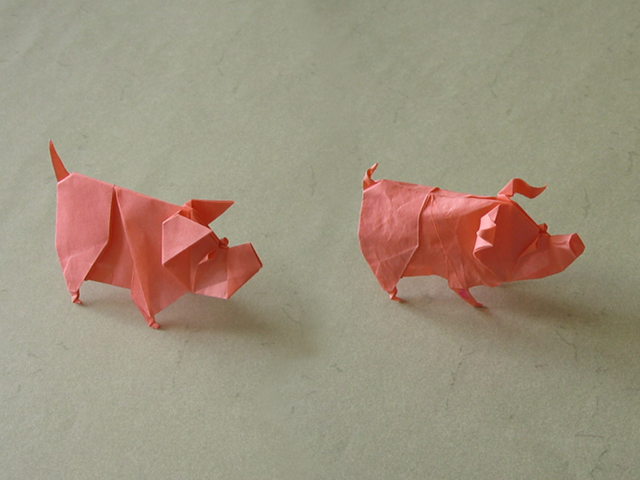
Paper: 22cm square of double tissue (treated with MC)
Model: 10cm long, 5.5cm high, 4.5cm wide
Yesterday I met up with Anna and Gerwin. As to be expected, we ended up in a paper shop. I want to start making double tissue and tissue foil, so we searched for some nice tissue paper. Having found a selection of different colours, I said that I might take a sheet of each one - except for pink. Shortly before Anna and Gerwin left they showed me some of the double tissue they made - and amongst the sheets was - of course - a pink one. Gerwin gave it to me, and said pink is at least good for pigs. And I promised I'd fold a pig just for him!
We'd discussed Quentin Trollip's creations, and the model of choice hence is his pig. I really like his work. And because this story is all about experimenting, I decided to take two pictures of the pig - once before shaping (where the diagrams basically end), and once after shaping. Can you figure out which is which?
Comments
Submitted by Anonymous (not verified) on 8 July 2009 - 12:39am Permalink
mc
hi sara what do u mean by treated with mc
Submitted by Sara on 8 July 2009 - 6:48am Permalink
Re: What is MC?
MC is short for methyl cellulose, a glue used for preparing paper. The glue seeps into the paper, thus making it crisper. It is especially helpful if you want to fold with tissue paper, mulberry paper, or other thin, but very soft types of paper.
Tissue paper is often too thin to fold with, so many origami enthusiasts make double tissue: you glue together two sheets of tissue paper using methyl cellulose. Anna and Gerwin gave one sheet of their double tissue.
If you find non-bleeding tissue paper (i.e. it does not bleed colour when wet), you can also make duo coloured paper with this technique. More often, though, duo coloured paper will be tissue foil. This is a sandwich of tissue, foil, and for the duo effect, another layer of tissue. As MC doesn't penetrate foil, you then either use spray glue or white glue. Apply it to the foil, and then roll the tissue paper on it. The foil prevents the back colour affecting the front one, and can even intensify the colour.
Having said all this - I've never treated paper with MC yet, and I've only tried making tissue foil twice with spray glue. So all of the above is mostly what I've read, and I apologize if any of the information isn't quite spot on.
But! I've now bought both MC (I bought a wallpaper paste that's based on MC) and white glue (a glue that you can also use for wallpaper, mostly if the wall covering is problematic). I also got some tissue paper, and foil's always in the kitchen. So I'm ready to start experimenting. :)
Submitted by Anonymous (not verified) on 9 July 2009 - 1:08am Permalink
thnxs
hey sara thanks for the tip about the paper i tried the thing with the mc (actually i used starch paste) and made some double tissue but the tissue i made got all crinkly how can i prevent that?
Submitted by Sara on 9 July 2009 - 6:17am Permalink
No experience
Given that I've never used MC before, I'm not the right person to ask. My plan is to align two sheets on a glass surface, then cover them with MC, and let them dry on the surface.
You might want to try ironing the paper carefully, i.e. on low heat and not staying on a place for too long.
-- Sara
Submitted by Anonymous (not verified) on 29 December 2009 - 7:34pm Permalink
did you wet-fold it (right)
did u wet fold the one to right or is it the paper? cause i didnt wet fold mine ( i never wet fold anything but flashers by shafer)and it looks the same but not as 3-d as yours ( and yes i did read the thing up there about anna and gerwin -_-)
Submitted by Sara on 29 December 2009 - 10:28pm Permalink
Somewhat wet-folded
I slightly dampened the finished pig (left) to then shape it (right). I think all the shaping could have been done in a totally dry state, though. I also think truly wet-folding (start with dampened square) would be really interesting for this model.
If I remember correctly, Quentin Trollip (almost) never wet-folds, but rather rolls the paper over his fingers to give them shape.
-- Sara
Submitted by Anonymous (not verified) on 10 May 2010 - 6:22pm Permalink
Ah i did it but my fold
Ah i did it but my fold (first fold ) looks more like a rhino rather than a pig:((((((
Submitted by Anonymous (not verified) on 16 May 2010 - 4:21am Permalink
pig
just to let you no wet-folded cardstock makes a good pig!
Submitted by Anonymous (not verified) on 18 May 2010 - 3:04am Permalink
Folded this :)
Hi Sara!
I just finished folding Quentin Trollip's pig this evening....it came out quite ok, I guess. I didn't wet fold it like you did, but instead shaped it as best as I could. I shall post pics of it by tomorrow most likely. I used tissue foil paper, though, and it came out a bit too crinkly in the snout area but I am happy with it for a first fold :)
- Ancella
(http://origamiancy.com/)
Submitted by Sara on 24 May 2010 - 4:30pm Permalink
Well done
Nice fold! Is the snout area crinkly, because you weren't sure how to fold it at first? I think I was a bit puzzled the first time I folded it, particularly with the eyes.
-- Sara
Submitted by Emile (not verified) on 12 March 2012 - 7:03pm Permalink
New links?
Hi Sara,
Unfortunately, it appears that the website with the diagrams is no longer up. Do you have another set of instructions on somewhere? Or a video of how to make the pig? It would be much appreciated!
Submitted by Sara on 18 March 2012 - 8:11am Permalink
Website unavailable
I'm not sure why Quentin's site is not available right now. But I'm hoping it will be fixed again! I did send him an email, but haven't gotten a reply. :(
Sorry, I don't know of another online source for diagrams.
-- Sara
Submitted by Jackrabbit Media (not verified) on 23 March 2012 - 6:46pm Permalink
awesome
I love this stuff. Awesome. My version looks like a crumpled up piece of paper, but I am getting better!
Add new comment