
Look and Feel
Model Suitability (out of 10):
Attributes (out of 10):
Ask non-origami people about paper mills, and someone will mention Fabriano.
Based in Italy, this mill is part of the Fedrigoni S.p.A. Group, the second largest special paper group in Europe. Their products vary from office paper, banknotes, drawing and fine arts paper, to handmade papers.
I found some interesting facts about paper on their website. The Arabs increased and spread the knowledge of papermaking throughout the west. And in the second half of the 13th century it reached Fabriano, a little town of the Marche inland. There they added three innovations which led to the rise of Fabriano as the cradle of modern papermaking: watermarking, the invention of the hammer mill (replacing the stone mortar and the manual wooden beater) and the use of animal gelatine for surface sizing, allowing for better writing.
They make a huge range of different papers. Here's what they say about Ingres:
"The particular grain of the surface and the highly light-fast colors are the principal characteristics of this laid paper. It is acid free and particularly recommended for deluxe editions, advertising (company presentations, posters, calendars, brochures, leaflets and catalogues), fancy paperwork and book binding applications, drawing (pastel, charcoal) and collage."
For some more information on Ingres see the Wikipedia article on it.
So, can we consider origami as "Fancy paperwork"?
Properties
- Thickness: The stated weight is 90gsm, same as the test result - 87-90gsm. The thickness measurements baffled us, ranging from 129 to 162 microns for the yellow paper. This is very thick for a machine made paper, and makes it unsuitable for our purposes. The white paper was much better at 130-139 microns. This is the same thickness as a dollar note!
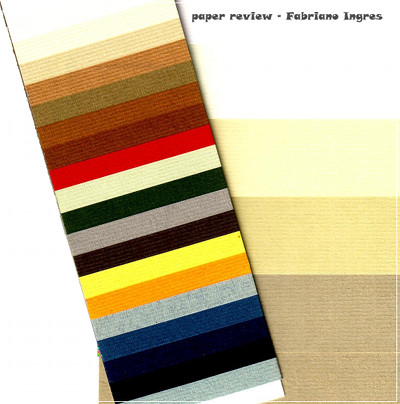 The old colors are vivid and still sold, but the new palette is very limited.
You can also find 160gsm Ingres paper. - Sizes: B1 (707mm×1000mm) and B2 (500mm×707mm) are the most common sizes.
- Colors: Like Elephant Hide, Fabriano has decreased the number of colors from 21 bright colors to only five: ivory (cream-brown), light brown, ash (grey), ice (bright white) and white.
- Paper Coloring or Colorability: This is a print paper, and as such it handles color nicely. Applying water color (by Ecoline) on the white paper gave a crisp blue. One application of color did not show on the other side, but two did. The paper curled a little when wet, but when dried under glass it came out flat again with no change in its proportions.
Texture: It's slightly rough and reminds me of Tant. It has the same color on both sides. The lower side has a distinguished look of ripples - 6 straight lines in every centimeter. In the other direction there is a similar line every inch. The grain direction runs parallel to the 100cm side of the B1. The upper side is smoother and the lines are barely visible, but with a back light you can see the corrugated texture.
- Photogenic: The old palette was very colorful and vivid. The unique texture brings warmth into the image and the corrugation on the surface is highly visible. It's like the finger-print of this paper.
- Aging and Wear and Tear: The numbers in the test machine are high, 870-920, second only to Elephant Hide (~1130) and almost double that of printer paper (~550). Being acid free should promise years of vivid colors, but we do not have enough experience with it. 8.5 out of 10.
- Memory: Good. Again, it reminds me of Tant. Reopen a crease and you can see and feel it. 8 out of 10.
- Forgiveness: Good, almost very good. There is no problem in reversing a fold. 8 out of 10.
- Tensile Strength: We refer here to the maximum stress the paper can undergo while being stretched or pulled. With the grain, the paper can hold up to 7.4 Kg before tearing; 3.4 against the grain. Those numbers are much like printer paper. 7.5 out of 10.
- Bending Resistance: This section rates the amount of force you need to apply to get a sharp crease and how strong the paper is while being curved (like during the puffing of the PowerPuff unit). Curving is a strong point. The paper is sturdy and although there is a difference between directions, both give a formidable Powerpuff unit. The only problem is the ripples when you try to fold a straight line at a small angle to the ripple direction. All in all - very good. 8.5 out of 10.
- Where to buy: This is not specifically an origami paper. It is mostly for painters, and as such, it is highly accessible. Just Google search for an art supply store near you.
Test results
Traditional use
Traditional Crane, 15×15cm
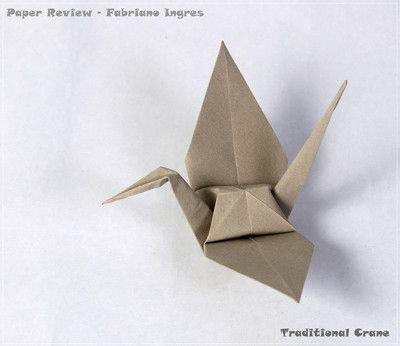
Nothing special here, the paper is folded easily but it is too thick to allow a sharp beak.
Action model
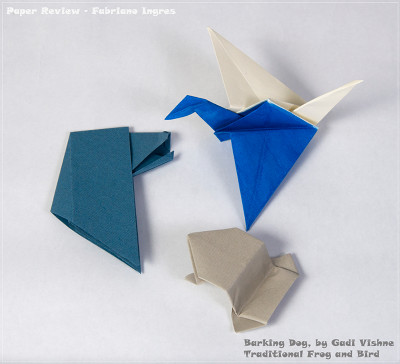
This group benefitted the most from the Ingres paper and its stiffness. The difference between with or against the grain is easily distinguished.
Barking Dog by Gadi Vishne, 15×15cm
Traditional Flapping Bird, 15×15cm
While pulling the bird's tail you can feel how the paper pulls the wings.
Traditional Jumping Frog, 15×15cm
The frog jumps pretty high, thanks to the springiness.
Tessellation
Pineapple tessellation by Ilan Garibi, 30×30cm
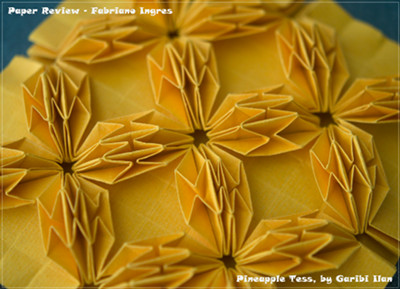
I was expecting some trouble with the along-the-grain folds of the grid, and was surprised to see that it was no big deal. Although the surface is wavy, and you can feel it by moving your fingernail over the bumps, it is hardly noticeable while folding . From time to time when you hit exactly the thickest part of the wave, you feel a bit more resistance, and the crease line may refuse to go straight. Reversing a fold is done easily, and you can feel that the paper "breaks" when changing the direction of the fold. During the pre-creasing, I found it hard to make diagonal lines, since the paper is not stiff enough to be broken on the corners of the grid`s squares. Finishing the pre-crease, you get the feeling the paper is too soft and pliable, more like a fabric than a paper. It also looks "messy" since all short creases tend to spill over, and every bend is visible. The first stage of the collapse went well, with the paper almost snapping into place. The second one was surprisingly even better, as it relied even more on the stiffness of the paper. In the end, the final result looked good.
Mystery tessellation by Ilan Garibi, 30×30cm
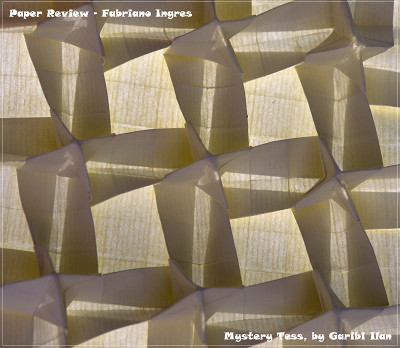
Again, I had no real problem with the grid. The collapse went well, but the process left some evidence of fatigue in the corners of the crosses. However, the paper will yield to strong finger pressure.
Complex
Pegasus by Satoshi Kamiya, 35×35cm
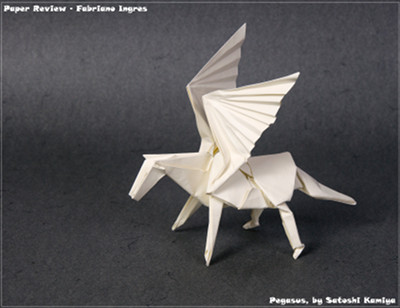
There is a nice resistance to pressure when folding in any direction other than parallel to the grain . You can feel it during the sink folds (step 37) but it was still comfortably easy. Going deeper into the more advanced steps, the shortcoming of its thickness start to appear. The body is hard to handle, and tucking in the belly layers was hard but still possible. The legs were not. I skipped the last small details of the hooves.
Owl by Katsuta Kyohei, 40×40cm
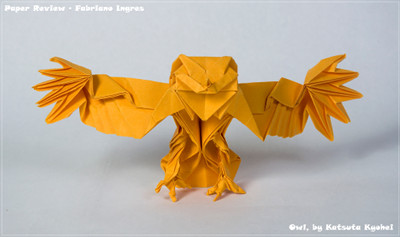
The paper is thicker than usual, but can be handled. As with all box pleating models, there are a lot of sinking folds, and the paper is well-behaved here. It thickness is felt when pre-creasing the legs. Before the sink - when you make a sharp crease to one side - the inner layers are hardly affected. My patience and ability came to an end when I tried to force the lower feather pleats - it is too thick. The final result is satisfying, but not ideal.
Modular/Unit Origami
PowerPuff modular by Ilan Garibi. 30 units, 12.5×12.5cm
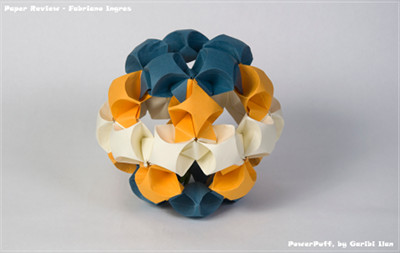
I chose 3 colors, white, yellow and blue. The stiffness is good for this model. I tried to go with the grain, against the grain, and to use both sides of the paper; all were folded easily . However the paper did tear when I tried to force it to the corner. Puffing the units was easier than usual, and the curve was sharp and clean. The assembly went like clockwork, tabs went inside pockets firmly, and the lock is strong. The final model is firm and holds its own weight easily.
3D models
Rat by Eric Joisel, 20×20cm
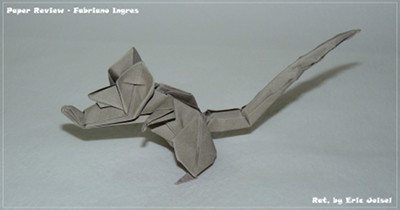
The paper is very heavy. It's very nice for curves, but only for few layers. Not the best for the Rat. It's hard to make multi-layered fold with it.
Fox Terrier by Francisco Javier Caboblanco, 20×20cm
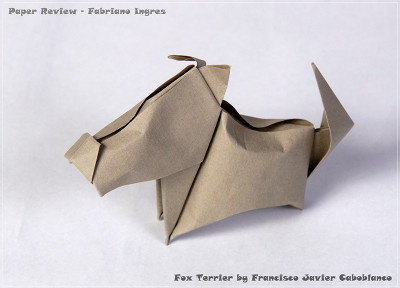
I know it's a simple model, but it does give a hint about the 3D behavior of the paper. The stiffness is apparent here, even with few layers, but the model benefits from that with the final moulding. Without wet folding the posture is almost as I want it, and with some moisture it is perfect.
Polar Bear by Giang Dinh, 24cm×24cm
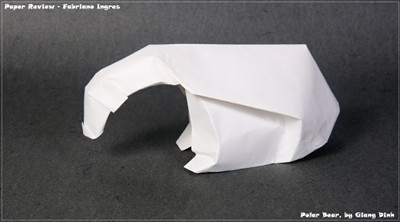
Shaping 3D models should be the best feature of this paper and it is. I used the 160 GSM paper (note that all other data is with respect to the 90 GSM paper) which is better suited to wet folding. The paper absorbs the water nicely if spread evenly (I am using Giang's method of a nasal spray bottle filled with water). It dries within 5-6 minutes. When dry it holds the new shape. However, with this thickness, some of the creases didn't require wetting at all.
Little Demon by Eric Joisel, 20×20cm
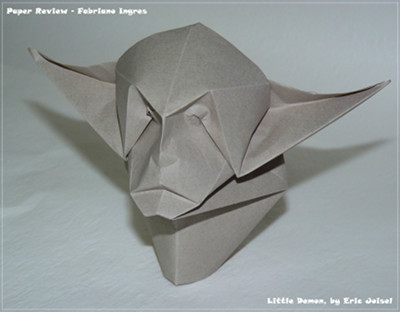
The paper is very good for models with few layers. It is easy to shape and mould large surfaces.
Rose by Toshikazu Kawasaki, 20×20cm
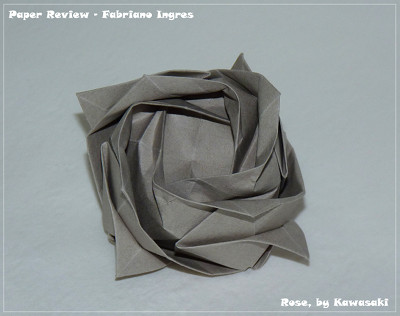
The thickness of the paper helps to hold the creases accurate even when collapsing something like this model. On the other hand it's hard to open the leaves for the finish.
Final verdict
As I go through this review, I see no excellence in any particular test or model. Strangely enough, this IS the strong point of this paper. It is a good paper, balanced, that can give good results in almost every type of fold.
Being thicker than other papers in the same weight group (around 90 GSM, like Tant and printer paper), it's stronger, can hold its own weight easily, and if you can find the lively old colors, it's a good buy. For traditional use it seems unnecessary to bother with measuring and cutting Ingres. On the other hand, action models will benefit from its properties. Complex models can be folded, but with difficulty, so for this Ingres is not highly recommended. Modular folding fares better since the paper has a lot of friction and a good weight to strength ratio. However, 3D models benefit most from this paper with its strong bending resistance and good behaviour in wet folding conditions.
Searching for origami images on Flickr appears to show that it is not one of the popular papers; only 60 images came up when searching for Ingres. Most are 3D models, masks and animals, but there are four tessellations and one Modular model. Widening the search with Fabriano I got 155 results.
Bottom line: best in none, good in all!
Note: with this review we have changed the score table! We are replacing memory, forgiveness, tensile strength and bending resistance with the suitability of the paper for a particular folding task. The previous 10 papers will be rescored appropriately.