
Look and Feel
Model Suitability (out of 10):
Attributes (out of 10):
Looking for a new paper to review, I went through my catalog and was struck by one particular paper. It had a wonderful pastel shade, with a smooth, marbled, appearance; it looked just like a thin version of Elephant Hide. So with that comparison in mind, I had to try it out! I bought a few sheets (one of each color) and in our last origami meeting I presented it to the guys. Oh, what excitement! The next day I made another order of 50 (yes, fifty) sheets for the three of us. It is that good! It is called Skytone, made by Mohawk Papers in the USA.
Mohawk is a fourth-generation family-owned business, started by George O'Connor in 1931 and still owned by the O'Connor family. Since the environment is one of their concerns, they are the first producers in the USA that meet 100% of their electricity needs from wind turbines. They also act according to the FSC certification.
As with most papers, this one is not specifically for origami, but was made for certificates, diplomas, invitations, awards and the like. It is acid free, 30% of it is recycled, and it does look beautiful. So, sure, you can have your wedding invitation printed on it, but can you fold a couple of swans to decorate the tables?
We have tested two thicknesses of paper out of the three available. Here are the results.
Properties
- Thickness: The measured weight is 90gsm, exactly as the official data. The thickness measurement is 123-131 microns, similar to Tant.
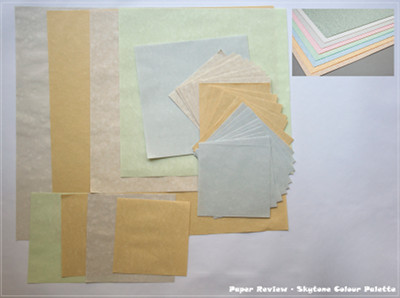 Showing all papers squares for this review
 - Sizes: There are only two options - A4, and big sheets at a size of 635mm×965mm, which is not in any familiar proportion (neither A, B nor C).
- Colors: There are 12 pastel shades, with lovely names such as Spring Green, New Bluestone, Aged, Pewter, and more. All shades are very light, with green, blue, pink, yellowish-brownish, and grey hues.
- Paper Coloring or Colorability: Applying water color resulted in very little buckling, but if you linger with the brush a little too long the color will seep through to the other side. It takes 3 to 4 minutes to dry. There is a change in proportion, but only a minor one.
Texture: Smooth to the touch, since they have a Vellum finish, with a parchment grade. And it does look like a parchment. No two sheets are alike due to the process of making them.
- Photogenic: On the one hand, the texture is wonderful and interesting, but on the other hand - the shades are pale, and without a perfect white balance it's very hard to capture the real hues of it. However, I like it very much.
- Aging and Wear and Tear: The result from the test machine was 420: not as good as Tant (750) - and even less than Kami (500). The paper is acid free, which should result in little change in color over time, but this is just an inference and not according to experience, since we have none with this paper. 6 out of 10.
- Memory: Good. Reverse a preliminary fold into a waterbomb base and the paper springs happily into the new position. Reopen a crease and you can feel the bump. 8 out of 10.
- Forgiveness: Very good. The first fold breaks the paper in a distinctive way so there is no problem in reversing it. 9 out of 10.
- Tensile Strength: We refer here to the maximum stress the paper can undergo while being stretched or pulled. With the grain, the paper can hold up to 6.6kg before tearing (Printer Paper can hold 7kg); but it can only hold 2.2kg against the grain (2.9kg for Printer Paper). Those numbers are somewhere in between Kami and Printer Paper. 7 out of 10.
- Bending Resistance: This section rates the amount of force you need to apply to get a sharp crease and how strong the paper is while being curved (like during the puffing of the PowerPuff unit; see below). This is a strong point, in relation to its thickness. The paper is springy and holds curves very well. All in all - very good. 8.5 out of 10.
- Where to buy:
- https://www.mohawkconnects.com/products/paper/mohawk-skytone
- Amazon.com (A4 sheets)
- The Paper Mill Store
- It may be found in an office supply store near you, you will have to check. Luckily, in Israel we have an official distributor, so I just place my order via email.
Test results
Traditional use
Traditional Crane, 15×15cm

This was my first time folding the paper and it felt good. It was stiff, very much like Elephant Hide, but much thinner. The crane requires a sharp beak and tail, but both are a little hard to achieve. The result is firm, strong and stable.
Action model

Barking Dog by Gadi Vishne, 15×15cm
For the Barking Dog I used a colored sheet and it works just fine.
Traditional Flapping Bird, 15×15cm
The flapping bird works great and it looks like it might work forever with no signs of fatigue. Also, the wings go up and down symmetrically.
Traditional Jumping Frog, 15×15cm
It's easy to feel the difference between with and against the fibers to make the frog jump higher. And it does! It jumps fantastically, not so far but with many somersaults!
Tessellation
Pineapple tessellation by Ilan Garibi, 30×30cm

Folding the grid was quick, easy and accurate. Reversing a fold was not as sharp as I thought, but it was also easy and accurate, no problem here. Precreasing went just as well. I thought that the stiffness of the paper would make it even easier, but it didn't. The first stage of the collapse was, well, just as easy. The paper is agile, yet stiff, and the “Snap!” effect is noticeable here. Now, testing a paper for tessellation is all about the collapse. A good paper will collapse easily and cleanly. This is exactly what this paper did. I managed to collapse the model without the help of wooden pins, since the paper has a very good memory.
Mystery tessellation by Ilan Garibi, 30×30cm

This time, folding the grid went slowly for one reason - the fold line is almost invisible. It gets better if you fold the lines twice, since the crease line is more visible this way. Reversing a fold requires some care, since the paper has some resistance to this action. Collapsing the model started slowly. The stiffness, usually a very helpful property, became a burden. The paper had a will of its own and wouldn't at first go where it was intended. Things improved on the next rows, but still, I was a bit disappointed, since the paper was not as good as I thought it would be. To finalize the model I needed to squash it into a sharp corner, which was quite easy to do.
Diamond Corrugation Vase by Ilan Garibi, 10×26cm

Since I had anticipated that tessellations would be the bread and butter for this paper, I had to check it with another model - a corrugation, actually. And since it is a thinner paper than usual for tessellations, I tried a small grid. The required grid is 10x26 as well, so my square size was 1cm×1cm. This model requires a lot of resistance from the paper, otherwise the surface just crumples under the pressure. I was glad to see that it worked very well and I had no problems collapsing it. The vase is firm and the molecules are nice and sharp.
Complex
Pegasus by Satoshi Kamiya, 40×40cm
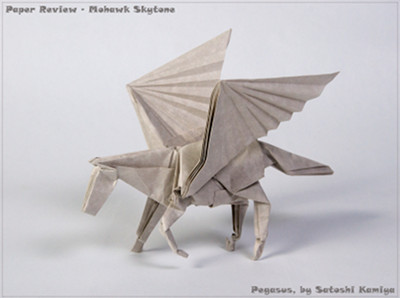
First folds are simple, but you can easily tell how stiff this paper is. Spreading it open on step 7 you can see how the centre resists being flattened. Since it is not as thin a paper as would normally be used for complex models, shaping the belly with so many layers is difficult, but still possible. Making the wings, with only two layers, gave a very nice result. As always, the final details are a bit of a fight, and I think I won. I am very happy with the outcome - well proportioned and stands proud!
Owl by Katsuta Kyohei, 40×40cm

What a pleasure to fold! Box pleating needs straight lines and many reverse folds, and this paper just worked great. Even with shaping, the paper is highly responsive. The wings were a true joy, the paper strong enough to hold the pre-creases needed for the rearranging of the layers (step 70), and yet thin enough to allow the many pleats that makes the feathers under the wing. Reversing the head sides caused no tears, unlike many other papers. The talons and the wings were the only hard part. I did manage to get lovely talons, but pleating the tail was too much. The final owl is just gorgeous!
Modular/Unit Origami
PowerPuff modular by Ilan Garibi. 30 units, 12×12cm

I chose three colors, very light blue, cream and champagne. Cutting went well, and folding the flat units was just as all other folds - easy, sharp and without any problems. Puffing the units was easier than usual; only here and there I hit a bump in the paper that didn't go where I wanted it. Assembling shows another benefit of this paper, the stiffness made it very easy to insert the tab into the pockets, and the next fold locked it perfectly.
3D models
Rat by Eric Joisel, 15×15cm

The Rat is no easy task, with many layers and sharp points, especially when I try to make it small enough to stand on a two cent coin. This paper handled the multi layers quite well, although the thickness was noticeable. Making straight long crease made me wonder if this paper already knows what a straight line is! The only downside was the thin legs; almost too thin to hold itself properly.
Fox Terrier by Francisco Javier Caboblanco, 15×15cm yellow square colored red

With less than 10 steps, this dog is ready. In the final position, his legs are wide open, so he can't actually stand. To correct that, I used some wet folding. Spraying a small cloud over the model, I could reshape the legs and head, hold it with tiny clamps, and after a few minutes all is well - the dog stands straight, and the head is shaped at will.
Long Tailed Dragon by Matthew Green, 30cm×30cm

This is a complicated model with many layers . I chose it to test the presumed weak points of Skytone. But it just delivered! The number of layers did not affect the beauty of the final model, although it almost tore at the nose, with so many crease lines intersecting there. The legs, although thin, can hold the model.
Swan by Yoshihide Momotani, 10cm×10cm

This is a perfect model for this paper; easy to shape, and with a small number of layers. It was a pleasure to fold, and a joy to the eye! Still, do not over-shape, because the paper becomes too soft after some repeated molding.
Wet Folding
Polar Bear by Giang Dinh, 25×25cm

I used the 176gsm paper. Spraying water with a nasal spray, the water covered the paper evenly. It soaked a little, and became easy to mold. The inner fold lines can be done while dry, as I did. To shape the legs, I added some water. The paper was never too soggy; always stayed firm, with no tell-tale color changes or 'tide-marks'. After drying, the model is firm.
Final verdict
This is a very good origami paper. It is thin enough (just like Tant), strong, remembers crease lines like an elephant, and satisfies many types of fold.
Its strongest point is box pleating, with tessellations a close second. The grid for both is easily creased and it is enjoyable experience. It is stiff enough for action models and modulars will also benefit from that, making model that are easy to assemble and will give a stable result that is able to hold its own weight. The heavy paper is very good for wet folds. It doesn't absorb much water, it dries quickly, and holds the shape accurately.
I find its appearance very appealing, very much like Elephant Hide, but I really would like to see some more dominant colors.
In Flickr the only results were a horse posted by Eyal Reuveni, (beautifully) folded from it, and some stars from me. There is no surprise here, because we both buy from the same vendor. No one else has ever posted a model from this paper, or if they did it's not tagged. Even so, this is a hidden gem!
We gave it a score of 9, which makes it one of the best papers we have tested. There are some weak points, but all in all, we bought 50 sheets.
Bottom line: buy it, fold it, love it!
Comments
Submitted by Anonymous (not verified) on 24 December 2012 - 5:42pm Permalink
Skytone
Sara,
I decided having a good stock of paper like this for modulars was a great idea, so I tried to order a ream of the Skytone Bluestone. Unfortunately got this response:
We apologize, but we have just been informed that the Skytone Bluestone paper you have ordered has been discontinued by the manufacturing mill. Unfortunately we will not be able to complete your order with this item. Please let us know if you would like us to check stock for an alternative option you may have in mind or if would like to proceed with your order without this item.
I don't know if it is just this color or the entire Skytone line. I'm still hoping to find something comparable. I was ordering from The Paper Mill Store.
Steve Phillips